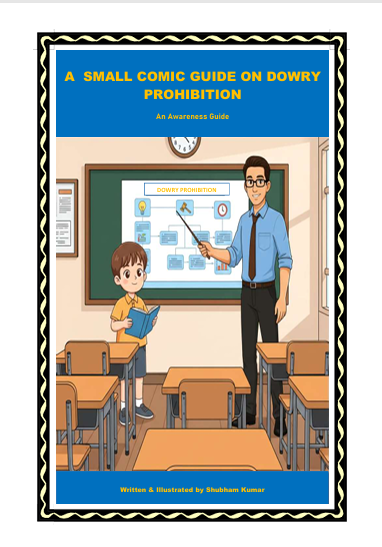
A Small Comic Guide on Dowry Prohibition
This comic explains the Dowry Prohibition Act, 1961 in very simple and easy words through a classroom talk between a teacher and a student. It helps readers understand what dowry means and how it is connected to marriage. It clearly shows that giving, taking, or even asking for dowry is a crime.
The comic explains key points like punishment for dowry, asking through messages or ads, and that such agreements have no legal value. It also shows that any dowry received actually belongs to the woman, which protects her rights. The roles of police, courts, and Dowry Prohibition Officers are also explained in a simple way.
It also includes important case laws like Satvir Singh v. State of Punjab, Appasaheb v. State of Maharashtra, and Arnesh Kumar v. State of Bihar to make understanding easier.
Overall, the comic spreads awareness that dowry is illegal and harmful. It encourages people to respect women and see marriage as a bond of love, not money.
This work is written by Shubham Kumar and designed by Priyanka Kumari under the guidance of Dr. Renuka S. Gubbeward.
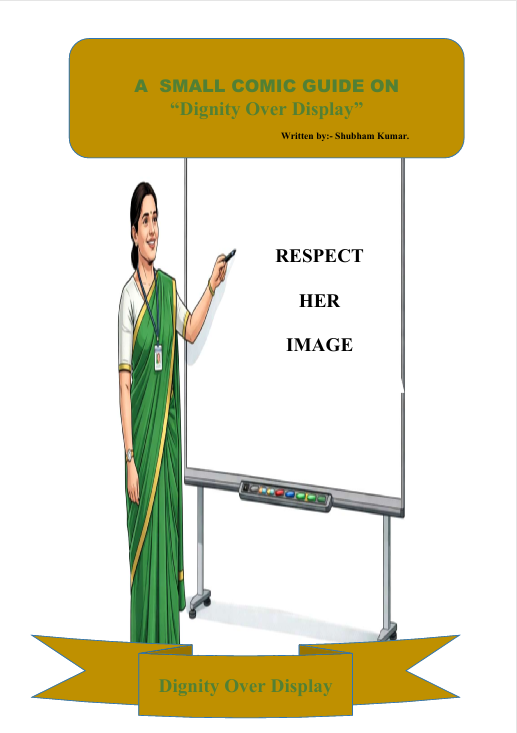
A Comic Guide on "Dignity over Display"
This comic, “Dignity Over Display,” presents the Indecent Representation of Women (Prohibition) Act, 1986, in a very simple and engaging way through a classroom conversation between a professor and a student. It explains the meaning of “indecent representation” and how it can harm the dignity of women and affect public morality. The comic shows where such representation may appear, like advertisements, books, films, and posters, making it easy to understand real-life situations.
It also explains the legal provisions, including the ban on indecent advertisements and the restriction on publishing or circulating such material. At the same time, it highlights important exceptions like art, literature, science, and public good. The inclusion of key case laws such as Chandrakant Kalyandas Kakodkar v. State of Maharashtra and Aveek Sarkar v. State of West Bengal helps readers understand how courts interpret obscenity and dignity.
Overall, the comic makes legal learning simple, interesting, and meaningful, while promoting respect for women. The work is thoughtfully created by Shubham Kumar and designed by Priyanka Kumari under the guidance of Dr. Renuka S. Gubbewad.
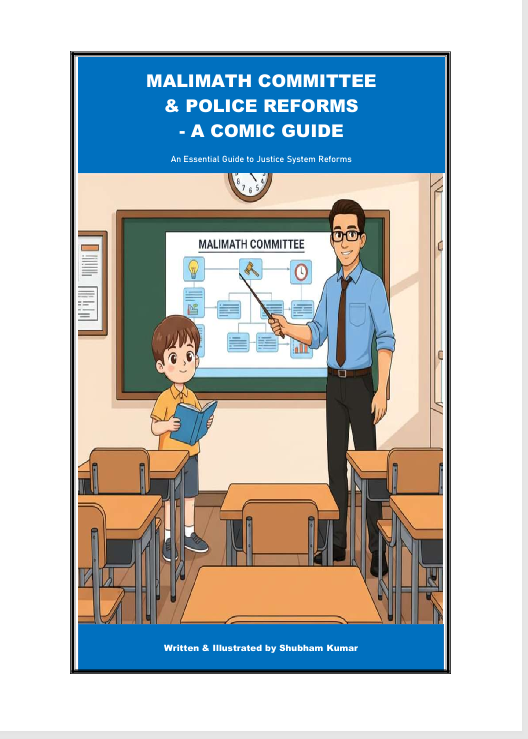
Malimath Committee Report and Police Reforms- A Comic Guide
This comic explains the background of the Justice Malimath Committee by first showing how the criminal justice system and police functioned before independence under the colonial Police Act, 1861. It highlights that the police system was designed mainly to control people rather than serve them. The comic shows problems like delay in justice, low conviction rates, poor investigation, and lack of protection for victims and witnesses, which created the need for major reforms.
This comic also explains why the Committee was set up and its main objectives—making the justice system faster, fairer, and more victim-friendly. It presents key suggestions for police reforms, such as separating investigation from law-and-order duties, improving training and use of foren…